Client Background & Goal
The client is a home improvement service business operating across multiple locations in the USA. The business depends on lead quality, not just lead volume.
Goal: Generate consistent, high-intent leads at a controlled and predictable cost across locations.
This is a high-competition, high-intent market, where poor structure quickly leads to cost escalation.
Core Problem
In multi-location home improvement accounts, ads usually fail due to strategy issues, not platform issues:
Mixed user intent across campaigns. Weak or noisy conversion signals.
Cost increases when scaling starts. Unstable performance due to frequent changes
The real challenge is how intent is captured and how the algorithm is trained.
Strategic Thinking (Intent, Signals & Structure)
The account was structured to separate intent clearly, not just split budgets.
High-intent users were prioritized for conversion actions
Conversion signals were kept clean and business-relevant
Campaign structure allowed learning to stabilize instead of resetting
This helped Google’s algorithm understand which users actually matter.
Execution Breakdown
Campaign Objective: Lead generation
Bidding: Conversion-focused, disciplined bid control
Targeting: High-intent search traffic without over-narrowing
Funnel Alignment: Ads → landing pages → clear service action
Tracking: Consistent conversion tracking used for optimization decisions
Optimization Logic:
- Signal quality was optimized before scaling
Learning phase was respected. - No unnecessary bid or structure changes.
- Waste controlled through intent clarity, not aggressive tweaks
Results
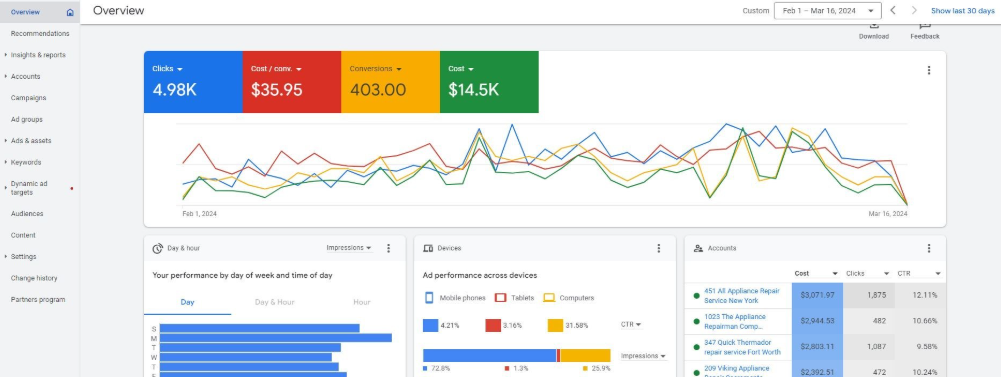
Clicks: ~4.98K
Conversions: 403
Cost per Conversion: ~$35.95
Total Spend: ~$14.5K
Final Note
This campaign succeeded not because of shortcuts, but because the platform was trained with clear intent, clean signals, and a structure built for long-term stability.
The result was predictable, scalable lead generation aligned with real business goals.
Case Study: The Bullsroom — Building a Strong Foundation in Stock Market Education
Introduction
The Indian stock market offers opportunities to learn about investing, market behaviour, and financial decision-making. However, for many beginners, entering the world of stocks can feel confusing. Financial terminology, candlestick charts, price movements, technical indicators, and market volatility can make it difficult to understand where to begin.
The Bullsroom is a stock market education and trading institute focused on helping learners develop a structured understanding of financial markets. Its educational approach centres on market fundamentals, technical charting, price action, analytical frameworks, risk management, and disciplined decision-making.
This case study explores a common challenge faced by aspiring market participants, how a structured educational approach can address that challenge, and how The Bullsroom can position its learning programmes to support students in developing stronger analytical skills.
1. Background: Understanding the Challenge
Many people begin learning about the stock market through short videos, social media posts, online discussions, and fragmented tutorials. Although these resources can introduce useful concepts, learning from disconnected sources may leave beginners without a clear understanding of how different market principles work together.
For example, a learner might recognise a candlestick pattern but struggle to understand the broader market trend. Another learner might understand support and resistance but overlook position sizing, stop-loss planning, or the effect of volatility on a decision.
These gaps highlight an important distinction: knowing individual concepts is not the same as applying them through a consistent analytical process.
The Bullsroom’s educational positioning addresses this need by emphasising structured learning rather than relying solely on isolated tips or market predictions. The objective is to help learners understand the reasoning behind market analysis and develop their own knowledge through study and practice.
2. The Core Problem
The central challenge for a stock market education programme is to make complex financial concepts understandable while encouraging responsible decision-making.
The key learning challenges include:
Lack of foundational knowledge: Beginners may not fully understand market terminology, order types, indices, or the difference between investing and short-term market activity.
Difficulty reading charts: Candlestick patterns, price structure, support and resistance, and trend analysis can be confusing without guided practice.
Overdependence on external opinions: Learners may follow unverified recommendations without understanding the reasoning or risks behind them.
Inconsistent decision-making: Emotional reactions to market movements can interfere with a planned analytical process.
Limited risk awareness: New market participants may focus on potential gains without considering possible losses, position sizing, or capital preservation.
Absence of a learning routine: Without a structured study plan, learners may struggle to measure their progress or identify knowledge gaps.
These challenges demonstrate why stock market education should combine conceptual understanding, practical exercises, and a strong emphasis on risk awareness.
3. The Bullsroom’s Educational Strategy
A structured programme can help learners move from basic financial literacy towards more developed analytical skills. The Bullsroom can organise its learning experience around the following educational pillars.
A. Building Strong Foundations
The first stage introduces students to the financial markets and the terminology needed to understand them. Topics can include how stock exchanges operate, the roles of market participants, equity shares, indices, order types, and the relationship between risk and return.
The purpose is to ensure that learners understand the environment before progressing to more complex chart-based concepts.
A strong foundation also helps students distinguish between long-term investing, short-term market analysis, and different financial instruments.
B. Technical Analysis and Chart Reading
Technical analysis introduces learners to the study of historical price movements and chart structures. Through guided examples, students can explore candlestick charts, trends, support and resistance, volume, and commonly used technical indicators.
Rather than memorising patterns in isolation, learners can be encouraged to ask practical questions:
What is the broader direction of the market?
Where are the important price levels?
Is the observed pattern supported by the surrounding market st